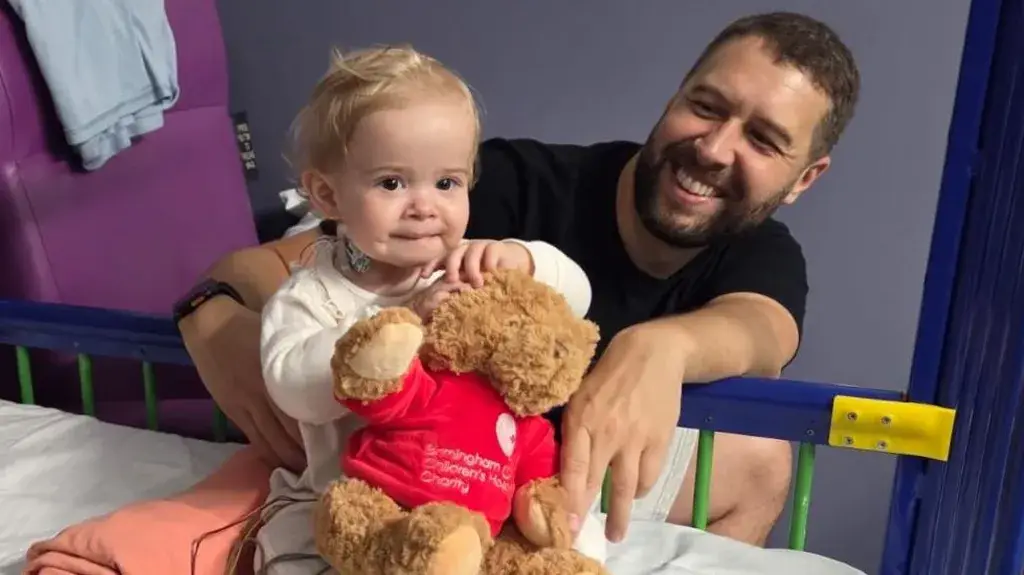
When Penny woke after open-heart surgery, her father noticed a familiar sign. “All of a sudden she had a twinkle in her eye,” Brad said. “The anaesthetic was getting out of her system and she was back. She was Penny again.”
The 13-month-old is recovering well after the life-saving operation at Birmingham Children’s Hospital. To prepare, her doctors used a 3D-printed replica of her heart; another model helped Brad and his wife, Lizzie, understand what their daughter was facing.
Penny has Tetralogy of Fallot, a congenital heart condition affecting about five in every 10,000 babies. Although she looked healthy, she could have become gravely ill without surgery.
Earlier in the year, at the family’s home in Broome, Worcestershire, Brad described the approaching operation as the day when, for him, “the world will stop” until he could see Penny’s face again.
At Aston University, biomedical engineers worked with doctors to create models from CT scans, ensuring that the four defects in Penny’s heart were represented accurately. One replica was the size of her heart and was used to show her parents what surgeons were dealing with. A larger, more detailed version was made for the medical team.
Consultant paediatric cardiologist Dr Tristan Ramcharan said the models allow doctors to see features such as holes and narrowing before surgery. In selected, more complicated cases, he said, they can also help the team understand where patches must go and where cuts are needed.
“It then makes the actual operation easier, more straightforward and potentially less complicated,” he said.
The collaboration between Aston University and Birmingham Children’s Hospital has produced models of a number of infants’ hearts. The project is run by the hospital’s cardiology team with the university and funded by the hospital’s charity.
Antonio Fratini, from Aston’s Engineering for Health Research Centre, said the models can be tailored to what surgeons need to see. Sometimes, he said, the team prints only part of a heart or makes cuts in the model so doctors can open it and look inside.
Weeks before Penny’s operation, Lizzie spoke about the wait ahead. “I can’t wait to be on the other side,” she said, adding that the family knew the surgery was something Penny needed.
On the morning of the procedure, Brad said he felt “apprehensive and nervous.” He and Lizzie carried Penny to the operating suite alongside a nurse and stayed with her until she had been given a general anaesthetic.
“I just crumbled,” Brad said afterwards. “I thought I was here to support Penny and Lizzie, and all of a sudden Lizzie was supporting me.”
The couple then waited five and a half hours for news. The operation was successful, although seeing Penny in intensive care was difficult at first. Brad said she initially needed support from an external pacemaker and that staff reassured the family.
Six days later, her parents were able to hold her again. “I took great pleasure in that,” Brad said.
Penny is expected to have further checks using a heart monitor in the coming weeks and, eventually, annual checks for the rest of her life. Ramcharan said he was delighted by how well she was recovering and that it was wonderful to see the family able to look forward to the future.